Skip to content

THE PROVOST’S OFFICE

Academic Excellence Through Education, Research & Service

We partner with the campus to ensure all students succeed and thrive, faculty and staff are supported in their research and scholarship and the campus community has the support it needs as a world-class public research university.

Undergrad Degree Programs

Graduate Degree Programs

Research Funding

Public University in the U.S. U.S. News & World Report, 2024

Among U.S. universities in research financed by the National Science Foundation (NSF)

Fulbright
Scholars

Marshall
Scholars

Rhodes
Scholars

Latest News

Texas Engineers Power Artemis II Mission

A quartet of astronauts is on the way back from an historic trip around the Moon—the first crew to do so in more than 50 years—and a handful of Texas Engineers are playing an important role in the mission. NASA’s Artemis II is the second in a series of missions that aim to set up a permanent presence on the Moon and prepare for future missions to Mars. This mission sent the four astronauts on a 10-day trip around the Moon, breaking the record for the furthest distance humans have traveled from Earth at more than 252,000 miles. Alumni from the Cockrell School of Engineering helped make this mission a reality. And they will continue to play a key role in the Artemis program as it progresses more…

Artemis Astronauts Showcase UT Geology Roots

The Artemis II crew safely splashed down last week after successfully flying by the far side of the moon, making them the first astronauts to travel back to the moon in over half a century. But years before they captured the world’s imagination with their historic space flight and pictures of the Earth rise over the far side of the moon, they were trained in field geology by a professor who put generations of Longhorn geologists through their paces. Mark Helper, now an emeritus distinguished senior lecturer at The University of Texas at Austin Jackson School of Geosciences, helped train every new class of NASA astronaut hopefuls since 2009 more…

Inside the Tower’s Herbarium

The UT Tower is full of history, much of it its own. Within its 27 floors sit many libraries, offices and administrators, but did you know that the primary occupants of some floors are plants? The Billie L. Turner Plant Resources Center, a collection of preserved plant specimens for botanical research and classification, occupies 10 floors of the Tower currently less suitable for people’s work or studying. Established in 1890, the herbarium contains over a million specimens, including one collected by Charles Darwin in 1835 during the voyage of the Beagle. The oldest specimen is over 250 years old, and the most recent one was collected this year.

Preparing for the State’s Future Energy Needs

Expertise and innovation lit up UT Energy Week. Co-hosted by The University of Texas at Austin’s Energy Institute and the Kay Bailey Hutchison Energy Center, the annual five-day event brought together energy leaders, researchers, policymakers and students for panel discussions, keynotes, networking and hands-on competitions. The 2026 lineup focused on the challenges and opportunities shaping the energy landscape — from nuclear power and geothermal resources to artificial intelligence infrastructure and critical minerals. 

Bringing Jane Austen to a New Generation

Jane Austen was born 250 years ago. Yet for millions of readers, she feels anything but distant. This is thanks in part to the innovative work of Janine Barchas. Barchas is the Chancellor’s Council Centennial Professor in the Book Arts at The University of Texas at Austin, an English professor in the College of Liberal Arts, and a 2026 President’s Research Impact Award recipient. The President’s Research Impact Award recognizes researchers whose work has fundamentally changed lives and perspectives.

5 Questions for Edoardo Baldini

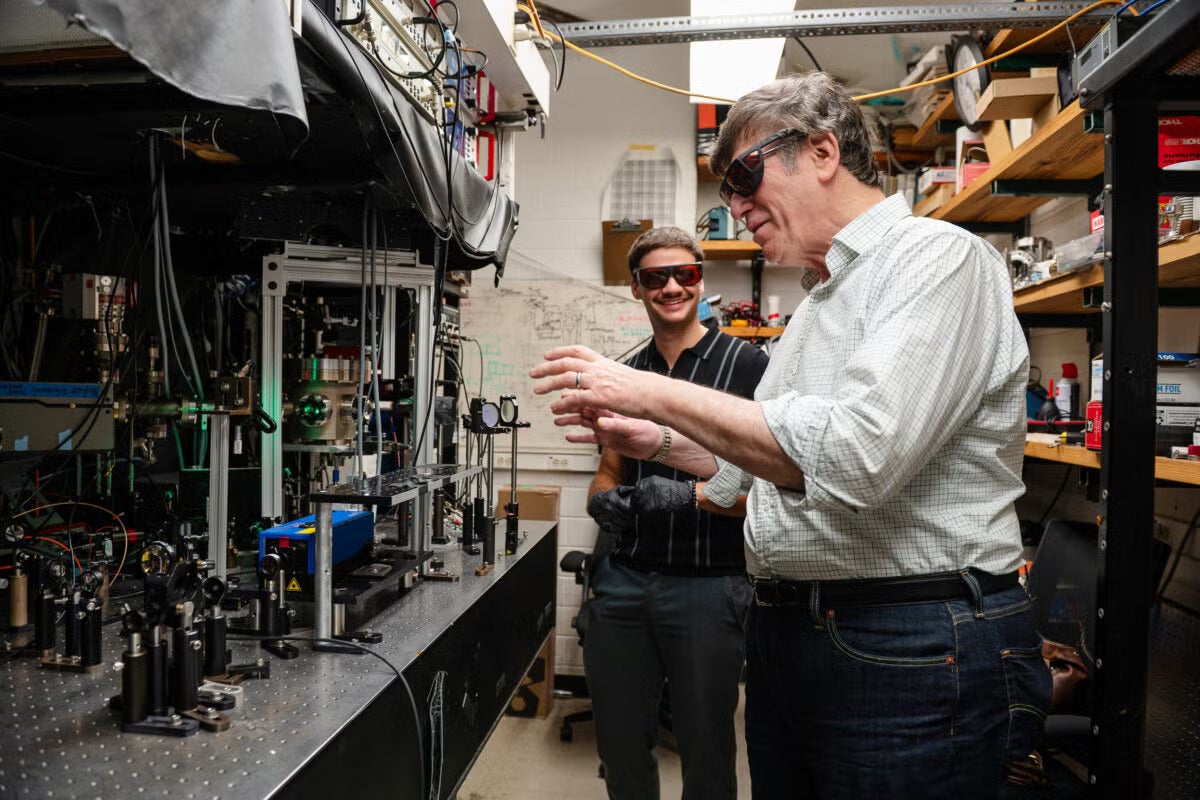
Edoardo Baldini is an assistant professor of physics in the College of Natural Sciences and a recipient of the University’s 2026 Research Paper Excellence Award. His research focuses on quantum materials. These materials are unusual because large numbers of interacting particles can organize into collective states with properties not found in ordinary matter. In the lab, researchers study how these behaviors form, what holds them together, and how they can be guided using light. This work helps reveal the hidden rules of nature and lays the groundwork for technologies that reduce energy loss, more…